
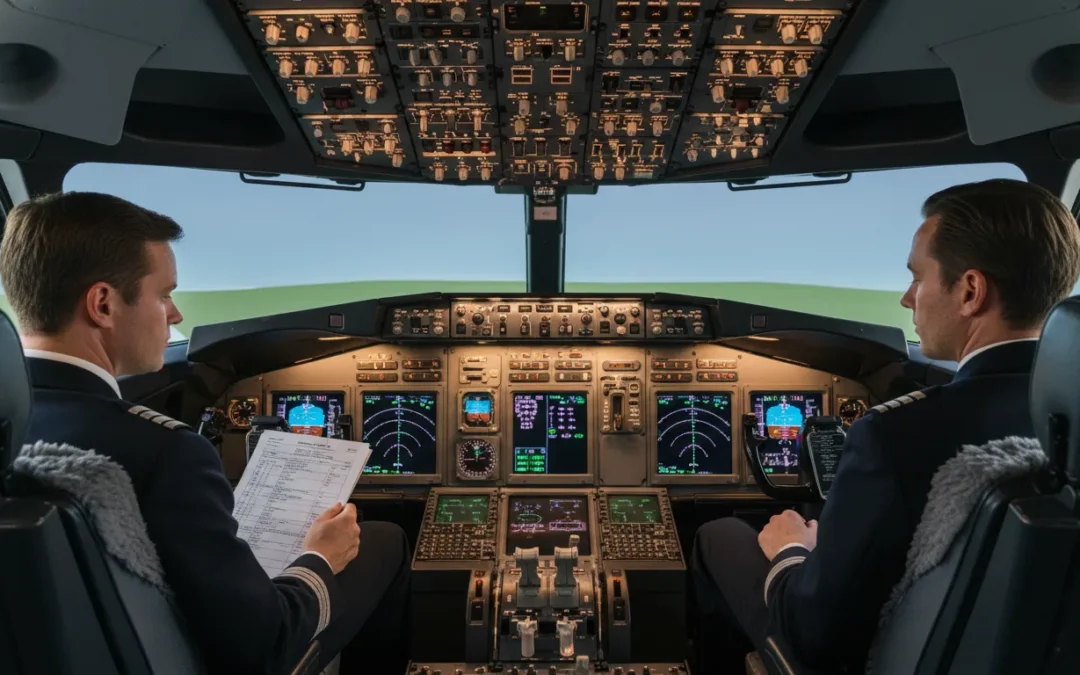
A long gap from the 737 cockpit makes preparation as important as proficiency. Before booking recurrent simulator work, returning pilots must verify the training path, equipment, and evaluation they actually need.
A Boeing 737 recurrent training checklist helps returning airline pilots confirm the right simulator, training path, and evaluation requirements before committing to a course. Start by identifying your recency gap, 737 variant, prior training records, operator requirements, and whether the event is recurrent or requalification training. The FAA notes that recurrent training may be accomplished in either a 737NG or 737 MAX full flight simulator, when applicable. Before travel, confirm ground review, simulator time, oral and practical evaluation scope, required documents, and schedule details with the training provider. That early check separates focused refresher work from a course that does not match the currency, variant, or checking objective you bring.
The key question is not simply where to rent simulator time; it is what must be confirmed before a returning pilot trains or checks. Boeing 737 recurrent training checklist: what to confirm first lays out those decisions in order. Here’s how.
Boeing 737 recurrent training checklist: what to confirm first
Start with your record, not a simulator slot. A returning airline pilot should know what must be renewed, checked, or reviewed before selecting training. The FAA outline of recurrent training includes ground instruction, simulator proficiency sessions, and oral and practical evaluations.
Your current training position
First, confirm the certificate and Boeing 737 type rating shown in your records. Then record the date of your last proficiency check and the basis for your next event. This keeps a recurrent course from being confused with requalification, differences work, or added preparation.
Ask your operator or training department which program, check, and records they require. Bring the due date, recent training history, and any assigned maneuvers or profiles. A provider can plan useful simulator work only after the training goal is clear.
- Confirm the certificate held and Boeing 737 type rating status.
- Record the date and result of the last proficiency check.
- Gather the operator or company training requirement.
- Identify the aircraft variant used in line operations or the upcoming assignment.
- Define the target outcome: recurrent check, proficiency practice, differences review, or requalification.
The aircraft variant
A Boeing 737 label alone is not enough for sound planning. Confirm whether your work relates to the Classic, NG, MAX, or a move between variants. The FAA fact record for this topic notes that the type rating covers several 737 variants, including the Classic, NG, and MAX.
Variant detail affects the questions you ask before booking. Identify the flight deck, manuals, procedures, and operator materials you must review. If you need a 737-800 setting, review the academy’s Boeing 737 type rating training page as part of that fit check.
The result you need
Be direct about the finish line. One pilot may need a scheduled proficiency check. Another may need focused practice before an operator event, or differences work before a new assignment. A clear request helps the instructor focus the session on the work you will face.
Share that outcome before discussing dates and simulator time. Also confirm whether you need an oral evaluation, a practical evaluation, or targeted preparation only. If check preparation is your main concern, review the academy’s 737 recurrent simulator checkride resource. This checklist helps align the course, variant, records, and check event from the start.
Records and currency items to gather before scheduling
A Boeing 737 recurrent training checklist starts with records, not packing for the simulator. Gathering them first lets the training center review your background and explain what to bring next.
Certificates and time records
Start with a clear copy of your pilot certificate and the medical certificate you plan to use. Add government photo identification and any documents your employer requires for training travel or facility access. Do not send sensitive documents until the training center gives you a secure method.
Prepare a logbook summary that shows total time, 737 time, pilot-in-command or second-in-command time, and recent simulator entries. Keep supporting pages ready if staff need to confirm an entry before a slot is set.
Include the date and result of your most recent 737 check, recurrent event, or qualification event. FAA material describes recurrent training as including simulator proficiency sessions and oral and practical evaluations.
Variant and training history
List every 737 variant in your recent history: Classic, Next Generation (NG), MAX, or more than one variant. Note which model you last trained in and which model you expect to operate. This helps staff ask the right questions about differences training or other review needs.
Use past records to show each 737 variant in your training history. Bring records that name the device, variant, maneuver profile, check type, and completion result. A certificate alone may not show that detail.
If your last event was long ago, review the 737 requalification training process before you call. It can help you describe the break in flying and the documents you still have.
Employer needs and gaps
Collect company or contract requirements before requesting dates. Bring the operator syllabus, check specification, training authorization, or written hiring requirement when available. If a chief pilot or employer must approve a course, note that contact and approval path.
Make a short gap note for any lapse in flying, training, medical status, or records. State dates you know, records you lack, and the kind of operation you are returning to. Do not guess at a missing check date; flag it for review.
- Certificate and medical copies, with expiration dates visible where applicable.
- Logbook summary and recent simulator or flight entries.
- Last 737 check record and earlier course completion records.
- Variant history, operator requirements, and a plain note on gaps.
Send an organized packet or inventory when scheduling staff request it. That lets the center focus the first discussion on course fit, records still needed, and available training dates. After booking, use the 737 recurrent simulator checkride guide for simulator-session preparation.
Recurrent vs requalification: which path fits your gap?
When a pilot returns after a gap, the right path is not decided by a checklist alone. Recurrent training, refresher simulator work, and requalification serve different needs. Your records, recent flying, operator program, and applicable rules shape the answer. Confirm your status with Las Vegas Flight Academy (LVFA) and your operator before booking a course.
Three paths at a glance
Recurrent training generally fits pilots who remain in an established qualification cycle and need assigned training or checks. FAA source material describes approved recurrent programs as designed to meet proficiency check standards. A Boeing 737 recurrent training checklist can organize records, manuals, and simulator preparation. It cannot determine a pilot’s required path on its own.
Before choosing, split the question into two parts. First, ask what training or evaluation your records and operator assign. Next, ask what extra simulator practice could help you arrive prepared. The answers may overlap, but they are not the same decision.
- Recurrent training: fits pilots still in a current program cycle. It centers on assigned ground, simulator, and checking work. Confirm program and operator requirements first.
- Refresher simulator work: fits pilots who want practice before formal training or evaluation. It centers on procedures, profiles, callouts, and crew flow. Confirm whether the practice meets any required event.
- Requalification: fits pilots whose gap or records may require a return pathway. It centers on restoring the qualification the role requires. Confirm records review and the approved course path first.
| Path | Best fit |
|---|---|
| Recurrent training | Current cycle with assigned training or check. |
| Refresher simulator work | Practice before a formal event. |
| Requalification | Gap or records issue that needs a return path. |
Where refresher simulator time helps
A refresher simulator session may help a pilot practice flows, checklist discipline, callouts, crew coordination, and expected profiles. It can be useful before an assigned evaluation or after time away from the flight deck. Still, practice is not an automatic substitute for required training, checking, or requalification.
If your next event includes simulator evaluation, review LVFA’s guide to the 737 recurrent simulator checkride. Then ask what documents, aircraft variant details, and operator materials should be available for your session.
When a gap may point to requalification
A longer absence, unclear training history, or expired operator standing can raise a requalification question. The key step is a records review, not a guess based on elapsed time. A pilot seeking that route can read LVFA’s 737 requalification training process before speaking with the training center.
Bring certificates, type rating details, recent training records, check history, and any operator direction you have received. LVFA and your operator can use those records to identify the suitable training path. That check prevents a refresher request from being mistaken for a formal qualification event.
For an initial conversation, note the last training you completed and the event you expect next. Add the simulator or 737 variant used, if known. Do not label your own course need; let your records and program requirements guide that choice.
Simulator readiness checklist for returning pilots
Materials and cockpit memory
A useful Boeing 737 recurrent training checklist starts before the simulator clock begins. Bring the current manuals and documents required by your operator or training center. Review limitations, memory items, flows, and standard callouts for the aircraft variant you will fly. If you have been away from the cockpit, practice slowly before adding pace.
Build each flow from its normal trigger, then confirm the related checklist. Say callouts aloud rather than reading them silently. This restores the link between a cockpit cue, the correct response, and the crew cross-check. Las Vegas Flight Academy’s 737 recurrent simulator checkride guide offers focused preparation for that session.
- Review normal flows, checklist responses, mode awareness, and standard callouts.
- Practice memory items exactly as written in your approved material.
- Mark items that require instructor review instead of relying on an old habit.
Procedures under pressure
Return to normal procedures first, including setup, briefings, taxi, takeoff, arrival, approach, landing, and shutdown. Then review abnormal and emergency events with the QRH ready. Know when a memory item ends and disciplined checklist use begins. The goal is not speed alone; it is stable, correct action with crew confirmation.
Recurrent simulator checks assess normal, abnormal, and emergency procedure handling in a safe setting, as described by the FAA recurrent training guidance. Prepare for high-workload profiles such as a rejected takeoff, engine failure, missed approach, or non-normal approach setup. For each profile, rehearse priorities: control the aircraft, manage the flight path, identify the condition, and use the approved checklist.
Do not turn QRH study into page memorization. Practice finding the right procedure, reading each step, confirming guarded actions, and noting items that change the landing plan. In the simulator, a calm QRH rhythm prevents rushed actions and frees attention for flight path monitoring.
Crew briefings and simulator habits
A returning pilot should rehearse as a crew member, not as a solo test taker. Before each event, state threats, roles, transfer-of-control language, automation plans, and go-around triggers. During the event, use clear calls, invite verification, and acknowledge changes. Good crew resource management makes workload visible before it becomes a surprise.
Use a short chair-flying session to connect each briefing with an expected profile. Run one normal departure and arrival, then add failures or weather changes that force a new decision. If an error appears, pause and trace the missed cue. Correct practice is more useful than repeating a rushed sequence.
Before training day, confirm the simulator location, reporting time, required records, and study material with the center. A general pilot simulator checklist can help you catch practical items before arrival. Arriving organized leaves more mental room for callouts, briefings, QRH discipline, and high-workload decision making.
Questions to ask Las Vegas Flight Academy before you book
Confirm the training path
Start with your training status, not a calendar date. Ask whether your record calls for recurrent training, requalification, or added differences training for another 737 variant. This helps the training center match the course to your certificate, recent experience, and operating needs.
If you have been away from the aircraft, explain how long and in which variant you last trained. Review the 737 requalification training process before the call, then ask which path applies to you. Do not assume a past type rating makes every return-to-training case the same.
Ask what the training event will cover and what evaluation is included. The FAA lists ground instruction, simulator proficiency sessions, and oral and practical evaluations as parts of recurrent training. Confirm how those items fit your planned event and any operator requirements.
- Am I booking recurrent training, requalification, or differences training?
- Does my prior 737 variant change the required training path?
- Will the event include an oral evaluation, a practical evaluation, or both?
Verify the simulator and preparation needs
Next, ask which 737-800 simulator is available on your preferred dates. Confirm whether the scheduled device matches the training you need. If you need work tied to a different variant, ask whether differences training must be completed first or paired with the event.
Ask for a document list before you reserve travel. Useful questions cover pilot certificates, medical information, type-rating records, recent training records, and operator paperwork. Also ask whether the academy expects advance study, flows, profiles, callouts, or company procedures before your first session.
If your focus includes an upcoming check, compare your plan with the academy’s 737 recurrent simulator checkride guidance. Then ask an instructor which profiles and normal, abnormal, or emergency procedures deserve review before arrival.
- Which simulator is scheduled, and is it suited to my required event?
- What records must I submit, and by what date?
- What should I study or brief before the simulator session?
Clarify schedule, crew plan, and price
Finish the call with practical details. Ask for available dates, daily session timing, cancellation terms, and the full price before booking, or contact LVFA about training availability before you reserve travel. Confirm whether the quote covers all required ground, simulator, and evaluation time, or whether any items are billed apart.
Ask whether the event is wet or dry training. For wet training, confirm who provides the instructor and any required crew member. For dry training, ask what the renter must provide, what standards apply, and whether instructor support can be added.
A clear booking call should leave no open items. Before paying, request a written schedule, training path, records list, simulator plan, and itemized quote. Those answers turn a Boeing 737 recurrent training checklist into a booking decision you can defend.
What happens during 737 recurrent training at LVFA?
At Las Vegas Flight Academy (LVFA), recurrent training is a focused return to 737 knowledge and flying skills. The usual flow includes record review, ground review, simulator work, and an evaluation phase. LVFA conducts this work in an FAA Part 142 environment in Henderson, near Las Vegas. The exact schedule depends on the pilot, operator, and approved training plan. Pilots should confirm the assigned plan before arrival.
Records and ground preparation
A practical Boeing 737 recurrent training checklist starts before the simulator session. Pilots should be ready to confirm their certificate, type rating, medical status, training records, and operator requirements. The training center can then match the event to the correct recurrent objective and any needed differences or proficiency work. Before the event, ask which manuals, checklists, and records to bring.
Ground review refreshes systems knowledge, limitations, procedures, flight manual use, and operational topics tied to the course. The FAA framework for recurrent training includes ground instruction, simulator proficiency work, and oral and practical evaluation. That makes study time useful: arrive ready to explain decisions, not just recite checklist items.
737-800 simulator proficiency work
LVFA operates Boeing 737-800 Level D full flight simulators at its Henderson training center. Instructors use the simulator to observe procedure use, flight path control, crew coordination, and sound judgment. Sessions may address normal operations, abnormal situations, and emergency procedures based on the approved event and the pilot’s needs.
This is also where preparation becomes visible in real time. Flows, callouts, automation use, checklist discipline, and communication must hold up as workload rises. Pilots who want a closer look at this phase can review LVFA’s guide to the 737 recurrent simulator checkride before arriving.
Oral review and practical evaluation
Recurrent training is not only simulator practice. An instructor or evaluator may ask a pilot to explain systems, limitations, performance choices, procedures, and responses to abnormal events. The practical portion then measures how that knowledge is applied in the simulator under the standards for the assigned training event. Pilots should expect preparation and performance to be reviewed together.
LVFA’s experienced instructors guide pilots through this process in a pilot-focused setting, rather than a one-size-fits-all pace. A pilot seeking details on the aircraft program can review LVFA’s Boeing 737 recurrent training information. Confirm course scope, records, and schedule with LVFA before travel, since recurrent needs can vary by pilot and operator.
Frequently Asked Questions
Does Boeing 737 recurrent training require a practical test?
Boeing 737 recurrent training typically includes an oral evaluation and a practical test in an approved simulator. The FAA identifies simulator-based evaluation as part of recurrent proficiency work. Before scheduling, confirm whether the course fulfills an operator check, a certificate requirement, or refresher goals. The required checking event depends on your role and approved training program.
Can I complete Boeing 737 recurrent training in either an NG or MAX simulator?
The applicable FAA guidance permits certain Boeing 737 recurrent training tasks in either a 737NG or 737 MAX Full Flight Simulator. Your assignment still matters. Confirm your aircraft variant, operator program, differences training needs, and the simulator configuration before booking. A returning pilot assigned to the 737-800 may need NG-focused preparation even when broader regulatory guidance permits either platform.
What are the core components of recurrent training for type-rated pilots?
A Boeing 737 recurrent training checklist commonly covers updated manuals and regulations, aircraft systems review, normal procedures, abnormal and emergency scenarios, crew coordination, and evaluation preparation. The FAA identifies ground instruction, simulator proficiency work, and oral and practical evaluations as central elements. Pilots should also confirm operator-specific profiles, documents, and any differences requirements before arrival.
Does recurrent training satisfy proficiency check requirements?
Approved recurrent training may satisfy a required proficiency check when its curriculum, checking event, aircraft variant, and training center authority match the pilot’s operating requirement. The FAA treats approved recurrent programs as a route to regulatory proficiency standards. Pilots should verify acceptance with their operator or certificate holder before scheduling, especially after time away from line operations.
Ready to plan your Boeing 737 recurrent training?
Delaying your return-to-training plan can leave key decisions unresolved when your schedule becomes harder to adjust. Starting now gives you time to identify gaps, align your goals, and choose simulator work with purpose. A clear plan also helps you enter each next conversation with focused questions about your path back to readiness.
Ready to move forward? Clarify where you stand, what preparation you need, and which recurrent training path fits your return timeline. Before you commit time to travel or study, confirm the training focus and next steps that match your current needs. Contact Las Vegas Flight Academy to confirm your Boeing 737 recurrent training path and request a practical starting point for your return to the simulator.