
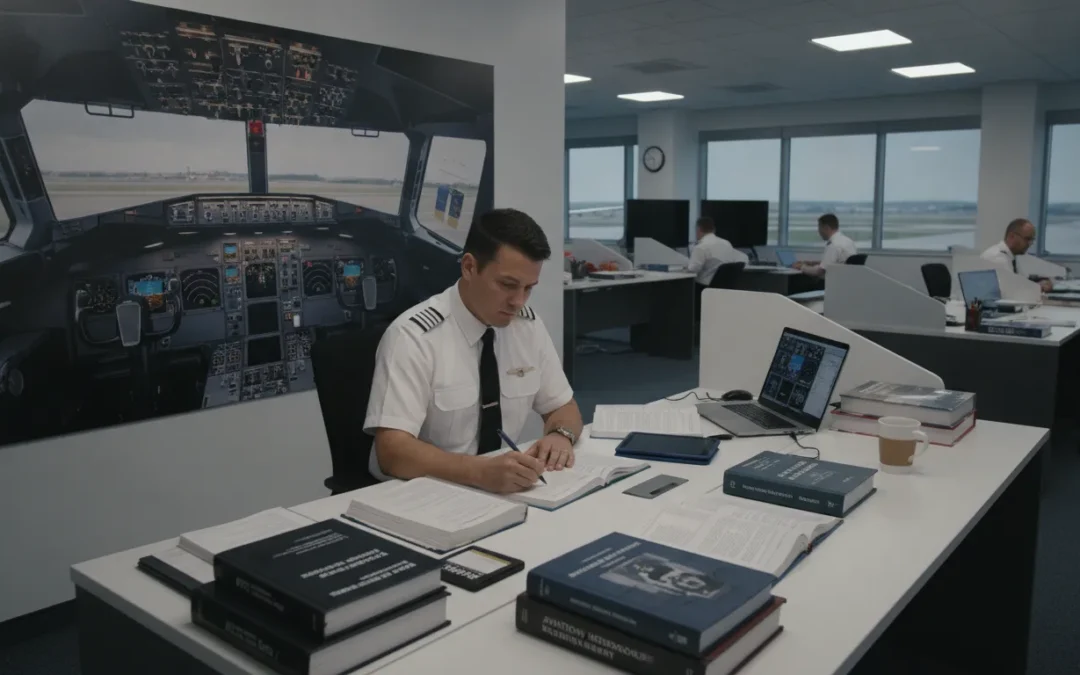
Transitioning from light twin-engine aircraft or regional turboprops to a heavy commercial jet like the Boeing 737 represents a major career milestone. The sheer volume of technical information, quick-action procedures, and precise cockpit layouts can overwhelm even experienced pilots. Knowing how to structure your study habits before ground school starts is the difference between a smooth checkride and unnecessary retraining.
Ready to earn your 737 type rating? Enroll at Las Vegas Flight Academy and train on our FAA-certified Level D full-motion simulator under experienced Part 142 instructors. Call (818) 489-1738 to discuss your training path.
Learning how to study for 737 type rating success requires a balanced approach that combines systems theory with hands-on practice. According to the FAA definition, a type rating proves you can fly that specific aircraft model. To earn this on the 737, you must master deep systems architecture, commit emergency memory items to heart, and build precise cockpit flows. Spreading your preparation over a four-to-six-week study timeline ensures you can focus entirely on simulator maneuvers once formal training begins. This guide covers every step of that preparation.
Mastering this complex aircraft requires a step-by-step approach that breaks down the cockpit into manageable pieces. Your preparation starts with the physical and electrical backbone of the jet. Let us examine the systems that make the 737 one of the most reliable aircraft in commercial aviation.
What Are the Key 737 Aircraft Systems You Must Master?
To succeed in your 737 type rating, you must master the electrical, pneumatic, hydraulic, fuel, and flight control systems. Each system operates through interconnected components and has specific failure modes that require immediate recognition and corrective action. Ground school covers these in depth.
A Boeing 737 type rating requires deep technical knowledge of the aircraft’s mechanical, electrical, and computer networks. A Part 142 ground school devotes significant time to these details. You must use your study time well to absorb this technical data before you enter the simulator.
Core Systems Architecture
Your primary study goal is to map the physical layout of the jet. Systems training covers the electrical, pneumatic, hydraulic, and fuel management networks. You must learn how each system functions in normal flight and how it behaves during a system failure. Learn the flow of power, fluid, and air through the aircraft. This mechanical logic forms the base of all your emergency checklists and cockpit actions.
Build a mental picture of each system using the Flight Crew Operations Manual (FCOM). Trace the path of fuel from the tanks to the engines. Learn how engine bleed air feeds the air conditioning packs. See how the three hydraulic systems back each other up to move the flight controls. This deep understanding helps you meet the FAA regulatory requirements for 737 training.
Mastering Automation and the Flight Management Computer
Modern jet operations rely heavily on computers. You must master the Flight Management Computer (FMC) and the Autopilot Flight Director System (AFDS). These digital tools reduce your workload, but only if you know how to command them. Study the FMC page structures, route entry steps, and performance setup inputs during your ground preparation.
To pass your checkride, you must show you can manage the interplay between yourself, the automation, and the physical systems of the jet. You cannot just let the computer fly the plane. You must monitor its choices and know when to take manual control. Study the Flight Crew Training Manual (FCTM) to understand how the automation reacts in different phases of flight.
Three Crucial Study Tools
You need three primary books: the FCOM, the FCTM, and the Quick Reference Handbook (QRH). The FCOM gives you the technical description of the systems. The FCTM teaches you the best techniques to fly the jet. The QRH contains the checklists for non-normal events. When you study a system in the FCOM, open the QRH to see what to do if that system fails. This active study method connects theory to real cockpit decisions.
| Manual | Purpose | When to Use |
|---|---|---|
| FCOM | Complete system descriptions, limitations, and performance data | Initial systems study; reference for normal and non-normal procedures |
| FCTM | Techniques and best practices for flying the 737 | Building your personal flow and scan habits |
| QRH | Quick-reference checklists for non-normal events | Cross-reference during system study; memorize the flow, then verify via QRH |
How Do You Master Memory Items and Limitations?
Memory items are immediate-action emergency procedures you must perform without a checklist. Aircraft limitations are the hard numbers , speeds, weights, and system restrictions , that define the 737’s safe operating envelope. Both must be memorized cold before your checkride.
A critical step when you learn how to study for 737 type rating certificates is committing these two specific groups of data to memory. They require different study methods to master.
What Are Memory Items?
Memory items are immediate action procedures that a pilot must perform without reference to a checklist during emergencies. When a red warning light or high-stress event occurs, you do not have time to open a book. Events like cabin depressurization, engine fires, or runaway trim require instant pilot action. Once you secure the aircraft, you then read the non-normal checklists to finish the task.
What Are Aircraft Limitations?
Aircraft limitations are hard numbers and rules that define the safe operating envelope of the jet. You must know these limits perfectly. They cover speeds, weights, and systems limits. Unlike memory items, which are action steps, limitations are factual parameters. Your examiner will test these facts during your oral exam and simulator sessions.
A Step-by-Step Study Guide
- Use Spaced Flashcards Write the emergency trigger on the front of a flashcard and the required action steps on the back. Do the same for limits, putting the system on the front and the numbers on the back. Review these cards daily.
- Practice Constant Repetition Write out the memory steps on a blank sheet of paper from memory. Do this multiple times a day. If you miss a single word or switch, start over. This builds deep mental pathways.
- Verbalize Your Actions Speak each step out loud as you touch the switch or control in your mental practice. This physical and vocal act reinforces procedural memory and mimics real cockpit coordination.
- Test Yourself Under Stress Have a study partner call out random emergencies or systems limits while you are busy with another task. This helps you recall critical data when your mind is split, which is exactly what happens in the simulator.
Building Effective Cockpit Flows
A cockpit flow is a systematic, geographic sequence of switch and control checks that ensures every cockpit component is correctly set for each phase of flight. Flows come before checklists , the flow sets the configuration, and the checklist verifies it.
In a commercial jet, you cannot rely on memory alone to configure the cockpit. Instead, pilots use structured methods known as cockpit flows. Under FAA Part 142 training, these flows act as a systematic path around the cockpit panels. Ensuring no control or switch is missed before you call for the checklist.
Mastering Flow Logic
Cockpit flows follow a geographic pattern. In a 737, this typically starts at the overhead panel, moves down to the glare shield, sweeps across the forward instrument panel, and ends at the center pedestal. Following this exact path every time builds physical familiarity. This structural habit ensures you configure the plane safely and quickly during your initial 737 type rating program.
Handling Normal vs Non-Normal Scenarios
Normal flows set up the aircraft for standard phases of flight, such as preflight, before start, and after takeoff. Non-normal flows help you manage system failures or emergencies. In both cases, the flow sets the switches, and the checklist verifies them. Learning and applying both types is central to 737 certification training.
Step-by-Step Guide to Practicing Flows
- Study the cockpit poster first: Spend time with a high-resolution 737 cockpit poster before you enter the simulator. Learn the physical location of every switch, light, and gauge.
- Trace the geographic paths: Move your hand from switch to switch in the exact sequence of the flow to build muscle memory.
- Verbalize every action: Speak your actions aloud , “fuel pumps on, window heat on” , as you touch each switch.
- Use mental visualization: Close your eyes and run through the entire preflight flow, picturing the state of each switch.
- Simulate normal and non-normal setups: Practice setting up for both standard flights and system emergencies on your poster to build flexibility.
Ready to take the next step? Contact Las Vegas Flight Academy to speak with a training advisor about our accelerated 737 type rating program. Our FAA Part 142 curriculum combines ground school with Level D simulator training at our Las Vegas facility.
Best Study Resources and Methods for Your Type Rating
Your primary resources are the FCOM, FCTM, and QRH from Boeing, supplemented by cockpit posters, digital flashcards, study groups, and guidance from your instructor. The right combination of tools makes the difference between passive reading and active mastery.
Preparing for a jet rating requires using the best tools to master the material. High-quality cockpit posters let you practice physical touch flows at home, turning movements into deep muscle memory before you step into a simulator.
Study Apps and Flashcards
Modern study apps help you build knowledge efficiently. Platforms like Quizlet work well for spaced repetition on systems and limits. This method helps you review hard terms just before you would forget them. Study these cards daily to keep the data fresh.
To understand how these tools fit into your training schedule, review a typical 737 type rating course schedule to budget your study hours. Starting early saves stress later.
The Power of Small Study Groups
Working with a group of two to four pilots is one of the most effective strategies. In these groups, discuss complex systems like electrical grids and fuel management. Quiz each other on limits and memory items. Group study builds confidence and keeps you on track.
Make sure to organize your personal study gear before class starts. Read about what to bring to 737 type rating training so you do not miss vital tools.
Ask Your Instructor for Help
Do not study in a vacuum. Ask your certified flight instructor (CFI) for a clear assessment of your strengths and weaknesses. Your CFI can tell you which systems need more time and how to adjust your approach. Use their training tips to guide your daily plan.
How Should You Prepare for the 737 Type Rating Oral Exam?
The oral exam tests your systems depth, regulatory knowledge, and operational understanding. You must explain how systems interact, how they behave in abnormal situations, and how to apply the appropriate checklists , not just recite memorized facts.
The oral exam is a critical gate in your type rating journey. You cannot pass by simply memorizing lists of facts. Instead, you must show the evaluator that you know how systems interact under normal and abnormal conditions.
Core Systems Focus
The oral exam will dive deep into the 737’s electrical, hydraulic, fuel, pneumatic, and environmental systems. For example, you must explain not just what happens when an AC generator fails, but how the electrical buses shed loads to keep critical flight instruments powered. Be ready to draw system schematics from memory and explain the pathways of fuel, hydraulic fluid, and electrical power.
Checklists and Limitations
Master the aircraft limitations and checklists. The examiner will quiz you on specific numbers , maximum speeds, weights, and environmental limits. Know these cold. You must also explain when to use memory items versus when it is safe to reference the QRH.
Mock Oral Sessions
Build confidence through active recall and mock oral sessions. Find a study partner or use a cockpit poster to simulate the exam environment. When preparing for your 737 checkride, verbalizing your answers out loud is key. Practice talking through a system malfunction from the first indication to the final checklist step.
737 Simulator Maneuvers and Practice Strategies
Simulator training at a Level D facility like Las Vegas Flight Academy covers steep turns, stalls, emergency descents, engine failures, and fire procedures. Each maneuver requires specific focus areas that you can practice mentally before your session.
Simulator training is a standard and essential component of any initial 737 type rating program. The training environment is highly structured to build confidence. Knowing what maneuvers to expect keeps you ahead of the aircraft.
What to Expect in the Simulator
Basic maneuvers like steep turns and stalls help you get used to the weight and pitch response of the Boeing 737. The curriculum then moves to emergencies such as engine failures, rapid cabin pressurization loss, and onboard fire procedures. Sessions build in complexity, starting with basic handling and ending with complex emergencies.
Strategies for Mastering Sim Scenarios
Arrive with solid instrument flying skills. Good scan habits are vital during emergency descents or sudden power loss. Always practice Crew Resource Management (CRM) and use standard callouts during every procedure. Working as a team keeps your situational awareness high. Read more about preparing for your 737 checkride to focus on consistency in your callouts and scans.
| Maneuver Type | Focus Area | Study Tip |
|---|---|---|
| Steep Turns | Pitch and power coordination | Memorize target deck angles and thrust settings for 45 degrees of bank. |
| Stalls | Angle of attack recovery | Practice the exact nose-down pitch and smooth thrust addition sequence. |
| Emergency Descents | Autopilot use and checklist execution | Learn memory items for rapid decompression before the flight. |
| Engine Failure | Rudder control and directional tracking | Anticipate yaw and use smooth rudder inputs to keep the nose straight. |
| Fire Procedures | CRM and checklist division | Divide duties clearly with your pilot partner. |
How To Study For 737 Type Rating: Your Study Timeline
A realistic preparation window is four to six weeks of self-study before your type rating course starts. This timeline allows you to build systems knowledge incrementally while keeping material fresh for the simulator phase.
Your study timeline should map to the six-day ATP-CTP and type rating structure that programs like Las Vegas Flight Academy offer. Here is a week-by-week breakdown of what to study and when:
| Week | Focus Area | Goal |
|---|---|---|
| Week 1 | FCOM systems overview | Read all system chapters once. Build a mental map of the electrical, hydraulic, pneumatic, fuel, and flight control architectures. Create one-page summaries for each system. |
| Week 2 | Memory items and limitations | Begin daily flashcard practice. Write out all memory items from memory. Start memorizing V-speeds, weights, and system limits. Review FCOM system chapters a second time with deeper focus. |
| Week 3 | Cockpit flows and FMC programming | Use a cockpit poster to practice geographic flows. Learn FMC page structures and route entry. Practice normal flows aloud until they feel automatic. |
| Week 4 | Oral exam preparation | Conduct mock oral sessions with a study partner. Review FCTM techniques for each phase of flight. Drill system failure scenarios and their checklists. |
| Weeks 5-6 | Simulator preparation and integrated review | Study maneuver profiles for steep turns, stalls, and emergency descents. Review all memory items and limitations daily. Practice CRM and standard callouts with your partner. |
Following this timeline ensures you arrive at your training ready to focus on the hands-on aspects rather than struggling with basic concepts. Your ground school days become reinforcement rather than first exposure.
Start your 737 type rating preparation at Las Vegas Flight Academy. Our Part 142 program combines systems ground school with FAA-qualified instructors and a Level D 737-800 NG simulator. Call (818) 489-1738 to enroll.
Frequently Asked Questions
What is the best way to study 737 aircraft systems?
The best approach is to break systems into separate topics such as electrical, hydraulic, fuel, and pneumatics. Study each system in the FCOM from start to finish, then cross-reference the QRH to see how each failure is handled. Use a cockpit poster to trace the physical locations of each system component. Daily review with flashcards reinforces the connections between components.
How long does it take to prepare for a 737 type rating?
Most pilots need four to six weeks of dedicated self-study before their formal training begins. The first two weeks focus on building systems knowledge and memorizing memory items. Weeks three and four cover cockpit flows and oral exam preparation. The final two weeks integrate everything through simulator maneuver study and mock oral sessions.
What study materials do I need for a 737 type rating?
You need the Boeing FCOM, FCTM, and QRH as your primary manuals. Supplement these with high-resolution 737 cockpit posters for flow practice, digital flashcards for spaced-repetition memorization. And a study group of two to four fellow pilots for oral exam preparation and systems discussion.
What are memory items in 737 training?
Memory items are immediate action procedures that pilots must perform from memory during emergencies, such as engine fires, runaway trim, or rapid depressurization. You must act immediately without referencing a checklist. Once the critical actions stabilize the aircraft, you complete the remaining steps using the QRH.
How do I practice cockpit flows without a simulator?
Use a high-resolution 737 cockpit poster mounted at eye level. Trace the geographic flow path with your hand from the overhead panel down to the glare shield, across the instrument panel, and to the center pedestal. Verbalize each action aloud and end every flow by verifying with the checklist.