
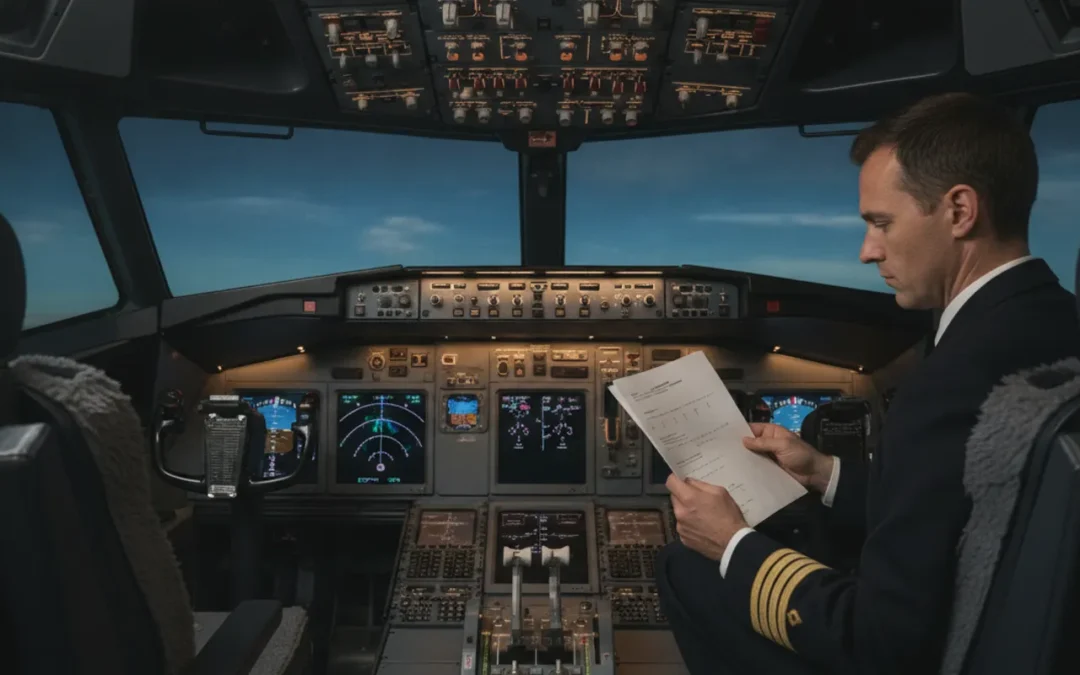
Pilots preparing for 737 engine failure simulator training should arrive ready to apply the approved syllabus, not to substitute internet notes for aircraft-specific instruction. A focused review of applicable procedures, callouts, task-sharing, and decision-making can make simulator time more productive. The right preparation also leaves room for scenario differences and instructor guidance.
Ask about 737 training options
What should 737 engine failure simulator training preparation accomplish?
Preparation is not an attempt to predict every event or memorize a generic sequence. Its purpose is to help a pilot recognize what the training syllabus expects, locate the approved references, and manage the learning process under instructor supervision. Engine-failure scenarios can differ by phase of flight, aircraft configuration, and training objective. The approved aircraft procedures and the instructor’s briefing govern the response.
Before studying, identify the course or checking event you are preparing for. A pilot attending initial type-rating training may have different learning goals from a qualified pilot completing recurrent training. Confirm the aircraft variant, course materials, and any required preparation with the provider. Las Vegas Flight Academy offers Boeing 737 initial and recurrent training; prospective students should confirm the current course scope directly rather than assume a particular scenario is included.
Keep preparation centered on four outcomes:
- Know where to find the approved material. Use the current manuals, checklists, and course documents supplied or specified by the training provider.
- Understand the training objective. Ask what competency or procedure the session is intended to develop, without requesting a script for an unknown event.
- Practice crew coordination mentally. Review the expected division of duties and communication standards in the applicable training materials.
- Be ready to learn from variation. A scenario may test recognition, judgment, or workload management, not only recall.
For broader aircraft familiarization, a pilot can review a structured guide to flying a Boeing 737 alongside official course resources. Treat general reading as orientation, not an authority for operating the aircraft.
A useful way to judge whether your preparation is on track is to ask whether it helps you use the supplied material more confidently. Can you find the relevant section without relying on a screenshot? Can you explain what questions remain, without improvising an answer? Can you describe what the instructor said the session is intended to assess? These are practical readiness checks. They do not replace a formal evaluation, but they make self-study more purposeful and help direct briefing time toward genuine uncertainties.
Which materials should pilots review before a simulator session?
Start with the documents identified by the training provider or the pilot’s operator. Depending on the course, those may include aircraft-specific manuals, approved checklists, standard operating procedures, course notes, and a syllabus. Confirm that the material corresponds to the correct aircraft variant and revision. A procedure remembered from another aircraft, operator, or training program can create confusion if it is treated as interchangeable.
When reviewing an engine-related section, focus on how the material is organized and how the crew is expected to use it. Do not rely on an online summary to supply memory items, limitations, or control inputs. Those details are aircraft- and operator-specific and must come from approved, current sources. If a reference conflicts with what you learned previously, flag the difference for an instructor rather than silently choosing one version.
A practical review can include the following:
- Confirm the 737 variant and the documents authorized for this course.
- Locate the relevant checklist or procedure in the current approved material.
- Review the terminology and callouts exactly as presented in that material.
- Note unclear points, including how the procedure fits the session’s stated objective.
- Bring questions to the briefing and follow the instructor’s direction.
Make the review efficient by separating facts you can verify from questions you need to ask. For example, mark the reference page or section, write down the exact point of confusion, and note whether it concerns terminology, roles, or how the course frames the exercise. Avoid copying a long sequence into personal notes if the source itself is available. A concise question such as “Which revision applies to this session?” is more useful than a private summary that may become detached from its source.
For systems context, use a source that explains the relevant aircraft systems without replacing formal procedures. The academy’s 737 systems overview can help orient a reader to system concepts. A separate 737 NG FMS guide is useful only for its specific subject; it is not a substitute for engine-failure procedures.
How can pilots prepare for different engine-failure scenarios?
The value of a simulator scenario is partly that pilots must apply training to a changing situation. Preparation should therefore focus on a repeatable method: listen to the briefing, identify the task, communicate clearly, use the approved references as directed, and keep the crew coordinated. Avoid rehearsing a single imagined event so rigidly that a changed setup becomes a distraction.
The table below is a study-planning aid, not a checklist or procedure. The instructor and approved course materials determine the actual response for each event.
| Scenario context | Useful preparation focus | Question to clarify in the briefing | Common preparation trap |
|---|---|---|---|
| Event during a ground or takeoff phase | Review the course’s decision-making framework, crew roles, and relevant approved references. | What learning objective and scenario assumptions should guide the session? | Assuming one remembered response applies regardless of the briefed conditions. |
| Event after becoming airborne | Refresh the applicable procedure location, callouts, task-sharing, and communication discipline. | Which approved materials and operator procedures apply to this training event? | Trying to memorize an internet summary instead of using current aircraft-specific material. |
| Event introduced during a higher-workload phase | Consider how to stay organized, communicate, and follow instructor direction while managing competing tasks. | What is the instructor assessing: procedure use, coordination, judgment, or a combination? | Focusing so narrowly on one technical action that crew communication is neglected. |
| Scenario with an added abnormal condition | Prepare to reassess the situation and use the references specified by the course. | Which elements are part of the exercise, and which details should be treated as unknown? | Pre-scripted expectations that do not match the actual setup. |
To make this flexible approach concrete, imagine receiving a briefing that differs from the study scenario you expected. First, listen for the instructor’s stated objective and any limits or assumptions. Next, identify what information is actually presented, rather than filling gaps with a remembered example. Then use the communication and reference process specified in the course. After the exercise, ask which part of your response demonstrated the intended skill and what should be adjusted. This sequence keeps attention on the learning task, not on guessing what comes next.
Keep the discussion at the level of preparation and training intent. A real aircraft emergency is not the place to recall an article. Pilots must follow applicable training, approved procedures, and operational direction. An overview from American Winds on responding to in-flight emergencies discusses general emergency priorities, but it does not establish 737-specific or operator-specific instructions.
How should pilots prepare for callouts and crew coordination?
Engine failure training tests more than an individual’s memory. It can also reveal whether the crew communicates, shares tasks, and maintains a common understanding as the scenario develops. Review the applicable callout policy and role assignments in the course material. If you are unsure how a callout is expected to be delivered or acknowledged in the exercise, ask during the briefing.
It can help to organize study notes around questions rather than a made-up script. For example: Which pilot is expected to initiate a specific communication? What information should be confirmed? When does the approved checklist enter the process? What should a pilot do if the other crewmember’s action or communication is unclear? The correct answers depend on the applicable procedures, so use these prompts to guide instructor discussion rather than fill in an answer from memory.
Before a session, a crew can also agree on a simple way to keep communication legible under workload, as prescribed by its training materials. That means avoiding vague or overlapping exchanges, listening for acknowledgments, and speaking up when the shared understanding is uncertain. In the simulator, a brief pause to clarify what was heard may be a useful learning point; the precise conduct remains governed by the exercise and approved procedures. A pilot should not invent a personal callout convention that conflicts with the operator’s standard.
Pilots preparing for initial training may also find it helpful to understand the overall structure of a 737 initial type rating. For study organization before a course, the academy’s 737 FMC preparation guide offers a separate example of how to turn unfamiliar material into focused questions. Its subject is FMC familiarization, so it should not be treated as engine-failure guidance.
How can pilots make the simulator debrief more useful?
A debrief turns a demanding session into a specific plan for improvement. Rather than writing down only whether a maneuver felt successful, capture what happened, what you noticed, and what you will review next. Separate observable events from your interpretation. For instance, note a missed or late communication as an observation, then identify the workload or knowledge question that may have contributed.
Useful debrief notes can include:
- Scenario setup: Record the exercise context as described by the instructor, without adding assumptions.
- Recognition: Note what cue or information helped you understand the developing situation.
- Communication: Record whether calls and acknowledgments were timely and clear under the applicable standard.
- Procedure use: Identify where you needed to locate, interpret, or apply approved material, and confirm any correction with the instructor.
- Next practice point: Choose one or two specific items to review before the next session.
Ask for feedback that is concrete and actionable. “What should I do better?” is broad. More useful questions include: “At what point did my communication stop supporting a shared plan?” or “Which part of the procedure should I review in the approved material before our next session?” The instructor can connect the feedback to the syllabus and the performance standard for that course.
A helpful debrief record can use three short columns: observed event, instructor feedback, and next action. For example, an observation might be that a clarification question came late; feedback might identify the moment when the crew’s shared understanding became uncertain; and the next action might be to review the applicable communication standard and bring a follow-up question. This keeps the plan specific without turning one scenario into a universal rule. Keep sensitive or operator-controlled material in the channels and formats permitted by the provider or employer.
If the session includes an unexpected outcome, do not turn it into a self-imposed rule for all future situations. Ask what the scenario was designed to teach, which assumptions were built into it, and how the approved procedure applies. The same discipline helps prevent a simulator lesson from being confused with an operational authorization.
What should pilots avoid when preparing for engine failure training?
Several common approaches make preparation less reliable:
- Using unsourced memory-item lists. A post, video, or note may be incomplete, outdated, or written for a different variant or operator.
- Practicing procedures from memory without checking authority. Familiarity can be useful, but it does not prove that a remembered sequence is current or applicable.
- Trying to predict the check or scenario. Over-rehearsing one setup can reduce flexibility when the instructor changes the context.
- Ignoring crew roles. A pilot who studies only technical recall may be less prepared to communicate and coordinate.
- Treating simulator performance as a universal operating rule. A training event has a defined context. Use the instructor’s debrief and approved materials to understand it.
- Arriving with unresolved aircraft or course assumptions. Confirm the variant, syllabus, required preparation, and materials with the provider.
Another unhelpful habit is collecting more study material than you can verify. A stack of screenshots, copied notes, and informal summaries can appear comprehensive while obscuring which version is current. Keep your working set small: use the materials your provider identifies, record source and revision information where appropriate, and set aside anything that cannot be verified. This reduces last-minute confusion and makes it easier to ask an instructor a precise question.
When reviewing the academy’s guide to FAA Part 142 training, keep the distinction clear: information about a training framework does not define a particular 737 procedure or guarantee that every possible scenario appears in a given course.
What should pilots confirm with a 737 training provider?
Before committing to a training plan, request clear answers about the course and preparation expectations. Ask which aircraft variant the training addresses, what materials students should study beforehand, how the training is structured, and what prerequisites apply. Also ask whether a particular engine-failure scenario or competency is included in the course you are considering. Avoid assuming that a general program description promises a specific event or assessment.
It helps to prepare a short inquiry list so the conversation stays focused. Ask which course documents will be supplied, whether you should review any material before arrival, and how the provider wants questions handled before the session. If you are returning for recurrent training, clarify whether the preparation expectations differ from those for initial training. If you are attending on behalf of an operator, confirm how operator procedures are incorporated and which materials govern. Write down the answers and resolve any mismatch between your expectations and the course description before scheduling.
For context on the training center’s background, review Las Vegas Flight Academy’s information about its operation. The academy is an FAA Part 142 training center and has Boeing 737-800 Level D full flight simulators, according to its company information. Contact the academy for current program scope, scheduling, and any details relevant to your own training needs.
Contact the academy about your training goals
Frequently asked questions about 737 engine failure simulator training
How should I begin studying for 737 engine failure simulator training?
Begin with the current course syllabus and approved aircraft-specific materials. Confirm the aircraft variant, review the applicable procedures and communication standards as directed, and bring uncertainties to the instructor. Do not use online notes as a substitute for authorized references.
Does 737 engine failure simulator training use the same scenario every time?
Not necessarily. Scenario details and learning objectives can vary by course and instructor. Ask the provider what its course includes, and prepare to apply the approved procedures and briefing rather than rely on a memorized scenario.
Can online articles teach a pilot the correct 737 engine failure procedure?
No general article should replace current, approved aircraft and operator materials or instructor direction. Online resources may offer context, but procedure details must be confirmed through the appropriate official training sources for the aircraft and operation.
What should I ask after 737 engine failure simulator training?
Ask which specific behaviors met the standard, where communication or procedure use should improve, and what material to review before the next session. Write down the instructor’s guidance and resolve any unclear procedure detail using the approved course references.
Good preparation for 737 engine failure simulator training is disciplined, aircraft-specific, and open to feedback. Use approved materials, confirm course expectations with the provider, and let the instructor’s briefing and debrief shape what you study next.