

Boeing 737 Circling Limitation Removal
A line such as “B-737 CIRC. APCH. – VMC ONLY” on a pilot certificate is easy to misread. It does not say the airplane cannot fly a circling approach. It records a limitation on the pilot’s privileges, based on the maneuvers demonstrated during the applicable practical test.
Review LVFA’s Boeing 737 type rating and circling limitation removal training options.
Boeing 737 circling limitation removal generally involves confirming the exact certificate limitation, completing any required and approved preparation, and demonstrating the applicable circle-to-land tasks to an authorized evaluator under current FAA standards. Training can prepare an applicant, but it does not guarantee a new certificate. The applicant must meet the standard during the check.
This guide explains the distinction between the limitation, the training, and the checking event. Because certificate wording and pilot circumstances vary, the first step is always to have an appropriate training provider or evaluator review the pilot’s actual certificate and intended outcome.
What the Boeing 737 circling limitation means
A circle-to-land or circling approach limitation is a limitation on the pilot certificate. It is not an aircraft limitation, and it does not mean that every circling approach is prohibited in every circumstance. The exact privileges and restrictions depend on the wording printed on the certificate and the rules governing the operation.
Certificate wording matters
Pilots may informally call the note a “circling restriction,” but planning should begin with the exact FAA wording. A common notation associated with a type rating is “CIRC. APCH. – VMC ONLY.” That notation reflects the scope of the practical test completed for the certificate or rating. It should not be interpreted from memory or from another pilot’s certificate.
The FAA’s current Airline Transport Pilot and Type Rating for Airplane Category Airman Certification Standards specifically addresses removal of a circle-to-land limitation on an ATP certificate or type rating. Those standards, current FAA guidance, and the applicant’s circumstances control what must be demonstrated.
It is different from operational authority
Removing a certificate limitation does not itself authorize a pilot to conduct every circling maneuver. A flight remains subject to regulations, approach-procedure restrictions, aircraft limitations, operator specifications, company manuals, crew qualification requirements, weather, and the pilot in command’s judgment.
This distinction is important. The certificate answers one qualification question. The operator and the specific flight answer several others. A pilot should evaluate both before deciding whether Boeing 737 circling limitation removal is necessary for a current role or future assignment.
Why might a pilot seek removal?
A pilot may consider removal because an employer, prospective assignment, or personal qualification goal calls for an unrestricted circle-to-land privilege on the applicable certificate or type rating. The benefit is specific to the pilot’s situation. Removal should not be treated as an automatic requirement for every Boeing 737 pilot.
Employer and assignment requirements
An operator may review certificate limitations when assigning duties or evaluating a candidate. In that situation, the pilot should ask the operator what is required and why. A written answer helps the pilot avoid booking training that does not satisfy the intended qualification need.
Some pilots also seek removal while planning a broader Boeing 737 type rating pathway. The limitation-removal question should still be handled as a distinct certification matter. It should not be assumed to be included in initial, recurrent, or other training unless the provider confirms that its current FAA approval covers the requested action.
Qualification does not replace judgment
A circling maneuver in a transport-category airplane demands careful planning and disciplined execution. The pilot must account for the published procedure, approach category, protected area, altitude, wind, visibility, runway environment, aircraft energy, and missed-approach plan. The fact that a certificate permits an operation never removes the obligation to decline it when conditions or procedures make it unsuitable.
For some pilots, the appropriate decision may be to retain the limitation because their operator does not need its removal. For others, removal may support a defined job requirement. The right decision starts with a specific operational need, not a general promise of better career prospects.
How does Boeing 737 circling limitation removal work?
The path is a certification process, not simply a short simulator lesson. Details can differ according to the certificate, the type rating, the applicant’s record, the training provider’s approvals, and the evaluator’s authority. Use the following sequence as a planning framework, then confirm every requirement before booking.
- Read the exact limitation. Provide a clear copy of the pilot certificate to the prospective provider or evaluator. Identify whether the notation applies to the ATP certificate, the B-737 type rating, or another rating.
- Define the intended result. Confirm what an employer or other requesting party expects. A vague request for a “clean certificate” is not enough to select the correct training and checking path.
- Confirm the current standard. Ask an authorized evaluator or qualified provider which current FAA standards and guidance apply. The FAA ATP and type-rating ACS includes specific guidance for removal of a circle-to-land limitation.
- Verify the provider’s approval. Confirm that the provider is currently approved for the requested training and certificate action, using the appropriate Boeing 737 aircraft or qualified simulator. Part 142 status by itself does not establish approval for every course.
- Complete required preparation. Follow the approved program or other applicable preparation identified for the applicant. Preparation may include ground instruction and simulator work focused on the applicable knowledge, risk-management, and flight-proficiency standards.
- Complete the required evaluation. Demonstrate the applicable tasks to an evaluator who is authorized to conduct the check and process the certificate action. The applicant must meet the current standard; attendance alone does not remove the limitation.
- Review the resulting documents. Confirm that the temporary certificate, application, and training records accurately reflect the action completed before leaving the training center.
Why advance confirmation is essential
A provider may offer Boeing 737 type-rating or recurrent programs without being approved for a particular limitation-removal request. A simulator may be highly capable without being qualified for the proposed check. An evaluator may be authorized for one action but not another. These are verification questions, not assumptions.
Send the certificate and a concise description of the desired outcome before making travel arrangements. Ask for written confirmation of prerequisites, device, evaluator, checking standard, estimated schedule, fees, and contingency terms. This step reduces the risk of arriving for training that cannot produce the intended certificate action.
Training versus checking: what each part accomplishes
Training develops proficiency. Checking determines whether the applicant meets the applicable certification standard. The two activities support each other, but they are not interchangeable. A completion record from training does not, by itself, remove a limitation.
What training should prepare the pilot to manage
Preparation for a circle-to-land evaluation should be grounded in the applicable FAA standard and the approved program being used. Relevant topics can include approach categories, published restrictions, obstacle-protected areas, minimum descent altitude, required visual references, aircraft configuration. Energy management, wind correction, stabilized-approach criteria, and the transition to a missed approach when continued flight is not appropriate.
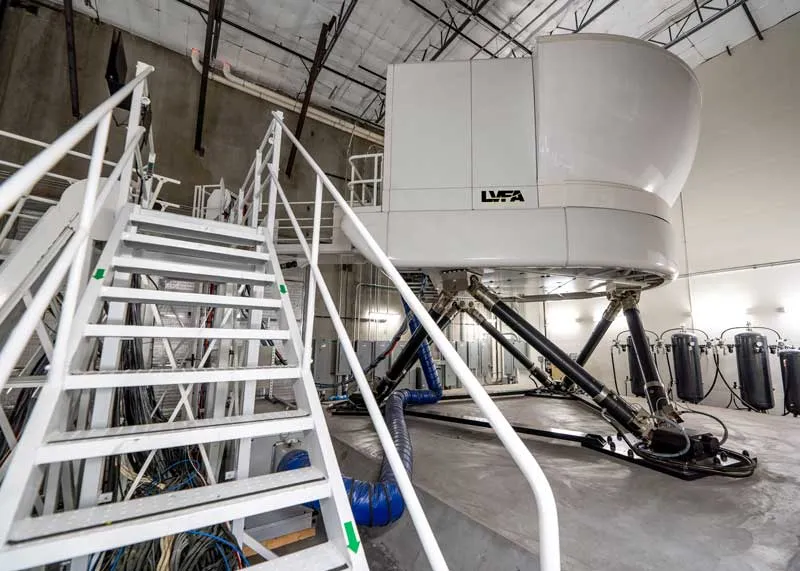
In a Boeing 737, energy and geometry require deliberate management. The pilot must maintain situational awareness while maneuvering close to the airport and coordinating the flight deck. A qualified simulator can provide repeatable scenarios and controlled exposure to changing conditions. Read more about the training environment in this account of a Boeing 737 Level D simulator session.
What the evaluator determines
During the checking event, the evaluator applies the current standard to the applicant’s performance. The evaluator, not the training center’s marketing language, determines whether the applicant met the standard and whether the requested certificate action can be completed.
| Element | Training | Checking |
|---|---|---|
| Purpose | Build knowledge, risk management, and proficiency | Evaluate performance against the applicable standard |
| Instructor interaction | Coaching, demonstrations, pauses, and corrections as permitted | Conducted under the evaluator’s test procedures |
| Mistakes | Used to identify and correct weak areas | Assessed under the current certification standard |
| Result | Readiness and required training records | Pass, fail, or other outcome determined by the evaluator |
No responsible provider should promise limitation removal before the check. The applicant’s demonstrated performance, the evaluator’s authority, and accurate completion of the certification process all matter.
Contact LVFA to have your certificate and Boeing 737 training objective reviewed before booking.

Questions to ask before booking training
Precise questions protect the pilot from booking the wrong course, device, or evaluator. Share the actual certificate and ask the provider to answer in writing whenever possible.
Approval, device, and evaluator
- Is your organization currently approved to provide the training required for my exact B-737 limitation-removal request?
- Which Boeing 737 aircraft or simulator will be used, and is it qualified for the proposed training and checking event?
- Which current FAA standard governs the check?
- Who will conduct the evaluation, and is that person authorized for this certificate action?
- Does the requested action apply to my ATP certificate, my B-737 type rating, or both?
Prerequisites, records, and contingencies
- What certificates, identification, training records, logbooks, endorsements, or other documents must I provide?
- What ground and simulator preparation is required under the applicable program?
- What should I study before arrival?
- What are the fees for training, checking, evaluator services, and additional simulator time?
- What happens if weather, device availability, evaluator availability, or applicant performance changes the schedule?
- Which documents should I expect after a successful certificate action?
A provider should review these questions before quoting a schedule. Be cautious if the answer relies only on a generic course description or guarantees removal without reviewing the certificate.
Las Vegas Flight Academy offers approved Boeing 737-800 NG training in Las Vegas, including circling approach limitation removal among its listed PIC training options. Pilots can review its Boeing 737 type rating programs, learn about the academy’s FAA Part 142 training center and simulators, and contact LVFA to confirm that its current approval fits the pilot’s exact certificate and requested action. Confirmation is required before scheduling.
What limitation removal does not change
Boeing 737 circling limitation removal changes the applicable notation on a pilot certificate after the required standards are met. It does not override the many rules and decisions that govern an actual flight.
Company procedures and operating limitations still apply
A pilot remains bound by regulations, the aircraft flight manual, operator specifications, company manuals, standard operating procedures, and any qualification or recency requirements. An operator may prohibit or restrict circling even when a pilot’s certificate does not carry the limitation. A published approach may also contain restrictions that determine whether circling is authorized.
Personal and crew risk-management decisions remain essential. Conditions that are technically permitted may still be unsuitable because of terrain, wind, visibility, runway environment, aircraft energy, crew experience, or other operational factors.
A circling maneuver is not a traffic pattern
A circle-to-land maneuver follows an instrument approach and requires the pilot to remain within the applicable protected area while maintaining required visual references. If those references are lost or a safe landing cannot be completed, the crew must execute the appropriate missed-approach procedure. Pilots must understand the procedure and their operator’s guidance rather than treating the maneuver as an ordinary visual pattern.
A type rating alone does not settle eligibility
Holding a B-737 type rating does not confirm that a pilot is eligible for a specific limitation-removal pathway. Certificate level, existing limitations, records, training-provider approvals, device qualification, and evaluator authority all matter. Review a broader overview of 737-800 type rating training requirements, compare 737 SIC and PIC type ratings, then seek advice specific to the actual certificate.
Finally, removal does not guarantee employment, assignment, or operational use of the privilege. It documents a certification outcome. Employers and operators make their own qualification and assignment decisions.
Frequently asked questions
Is a circling limitation the same as a restriction on the Boeing 737?
No. The notation is on the pilot certificate or type rating and reflects the scope of the applicable practical test. It is different from an aircraft limitation, a published approach restriction, or an operator’s procedures. Those separate restrictions may still apply after certificate limitation removal.
Does a Part 142 training center automatically have approval for circling limitation removal?
No. Part 142 certification does not mean a center is approved for every course or certificate action. Before booking, ask the center to confirm that its current FAA approval, simulator or aircraft, and evaluator arrangements cover the pilot’s exact B-737 request.
Can a training center guarantee Boeing 737 circling limitation removal?
No. Training prepares the applicant, but the applicant must meet the applicable standard during an evaluation conducted by an authorized evaluator. The evaluator determines the result. Providers should explain prerequisites, training, checking, and contingency terms without promising an outcome.
How long does circling limitation removal take?
There is no responsible universal estimate. Timing depends on the exact certificate action, applicable program, applicant readiness, required preparation, simulator availability, and evaluator scheduling. Obtain a written schedule only after the provider reviews the certificate and confirms its approval.
Does removal override an airline’s circling policy?
No. An airline or other operator may impose limitations that are more restrictive than a pilot certificate. Regulations, operator specifications, manuals, approach procedures, aircraft limitations, and crew judgment remain controlling for each flight.
Discuss your Boeing 737 training objective
Start with an accurate review of your certificate and the outcome you need. Las Vegas Flight Academy can discuss its currently approved Boeing 737 training options and help determine whether they fit your situation. No limitation-removal outcome is promised, and the academy must confirm its applicable approval before training is scheduled.
Call 818-489-1738 or review the Boeing 737 type rating program to begin that conversation.