
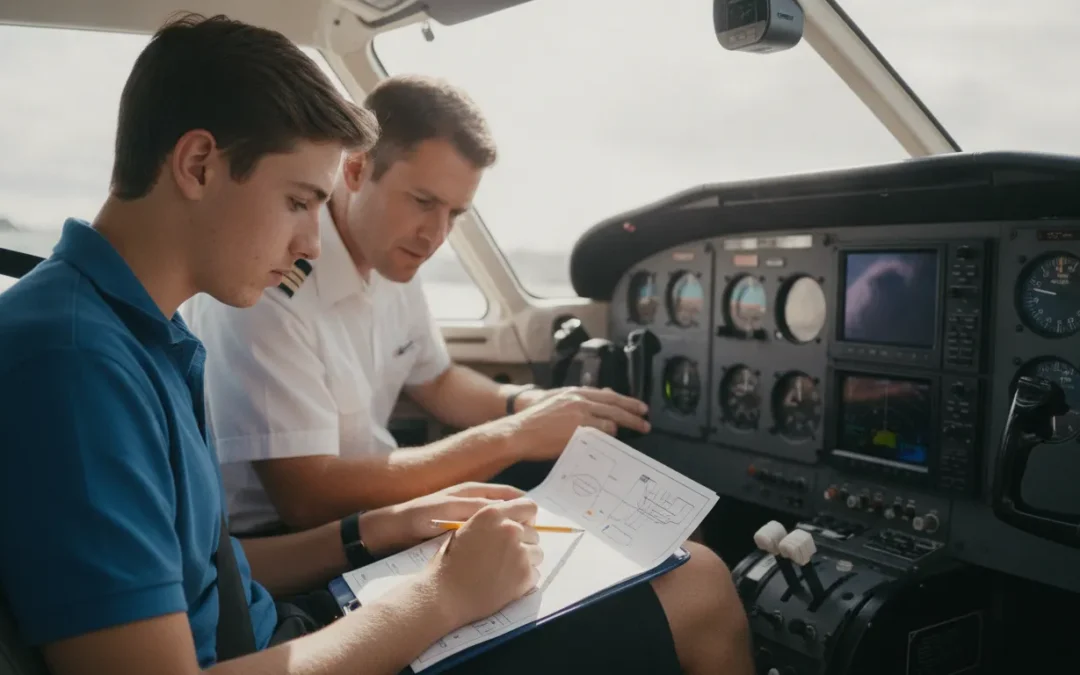
A Part 141 training course outline is the FAA-approved plan for one course at a pilot school. It names the lessons and the standard for each stage. It also names the aircraft, the training aids, the instructor qualifications, and the checks that decide whether you move on. Ask for that outline before you enroll. A brochure can describe the school. The outline describes the course you will actually be held to.
Las Vegas Flight Academy is an FAA Part 142 training center in Henderson, Nevada, not a Part 141 primary flight school. If you want the school list first, start with our aviation schools comparison. We train professional pilots on Boeing 737 Level D simulators, including ATP-CTP and 737 type rating work. The same habit applies on either side of that line. Read the approved course. Then ask what happens when you need more than the planned time.
Call (818) 489-1738 to ask which course fits your certificate
What is a Part 141 training course outline?
Under 14 CFR 141.55, each course a pilot school submits for approval must contain a training syllabus. It must also describe how that course is taught. The syllabus is the part you should read. It has to include:
- Prerequisites for the ground and flight portions, including any certificate, rating, experience, or knowledge the course expects before you start.
- A detailed description of each lesson, with the lesson’s objectives, standards, and planned time for completion.
- What the course is expected to accomplish for student learning.
- The expected accomplishments and the standards for each stage of training.
- The checks and tests used to measure those accomplishments at each stage.
The same rule also requires more than the syllabus. It asks for the ground-training rooms and the training aids. It asks for any flight simulator or flight training device. It asks for the airports where training flights originate. It also asks for the aircraft and special equipment for each phase, plus the minimum qualifications and ratings for each ground and flight instructor. If a school will not show you those pieces, you are not looking at the approved course. You are looking at marketing.
The FAA pilot schools page says an approved school must meet prescribed standards for equipment, facilities, personnel, and curricula. That approval is not a ranking. It is also not a promise that every graduate finishes at the minimum hour total.
Which outline items should you compare before you enroll?
Do not stop at the hour total on the first page. Line the outline up against the questions below. If the school cannot point to the item inside the approved course, write the answer down as “not in the outline” and keep going.
| What to check. |
Where it should appear.
What a useful answer looks like.
|
|---|---|
| Enrollment prerequisites. |
Where it should appear. Syllabus, before lesson 1.
What a useful answer looks like. Certificate, medical, English, and any knowledge the course expects on day one.
|
| Lesson objectives and standards. |
Where it should appear. Each ground and flight lesson.
What a useful answer looks like. You can see what pass means before you fly the lesson.
|
| Planned time. |
Where it should appear. Each lesson and each stage.
What a useful answer looks like. Ground hours and flight hours are planned, not guessed from a brochure.
|
| Stage checks and tests. |
Where it should appear. End of each stage.
What a useful answer looks like. The outline names who conducts the check and what it measures.
|
| Aircraft and special equipment. |
Where it should appear. Course description by phase.
What a useful answer looks like. You know which airplane, avionics, and special equipment each phase uses.
|
| Simulator or training device. |
Where it should appear. Course description, if one is used.
What a useful answer looks like. The device is named. You can see which lessons it covers.
|
| Airports and briefing space. |
Where it should appear. Course description.
What a useful answer looks like. Training flights have a listed origin airport and a place to brief.
|
| Instructor qualifications. |
Where it should appear. Course description.
What a useful answer looks like. Minimum ratings for ground and flight instructors are written down.
|
Bring this table to the visit. Ask the chief instructor, or the person who will recommend you for the checkride, to walk one stage with you. A school that trains under an approved course should be able to do that without hunting through a binder.
How do stage checks change the way you train?
A Part 141 course is built in stages. You do not simply log hours until you feel ready. You meet the standard for that stage, then you take the check the outline describes. 14 CFR 141.85 puts the chief instructor on the hook for that system. The chief instructor certifies training records, graduation certificates, and stage-check reports. The chief instructor also certifies end-of-course reports and the recommendation for course completion. Those duties can be delegated to an assistant chief instructor or a recommending instructor.
That is the practical difference from an informal lesson plan. Someone at the school is responsible for keeping the standard the same from one instructor to the next. The chief instructor also has to make sure each instructor passes an initial proficiency check before teaching the approved course. After that, the instructor needs a recurrent proficiency check every 12 calendar months. During training, the chief instructor or an assistant chief instructor must be available. That can be at the school, or by phone, radio, or other electronic means.
When you read the outline, ask three questions:
- Who conducts the stage check for the course you want, and is that person named as a check instructor or left as “chief instructor or designee”?
- What do you repeat if you do not meet the stage standard, and is that extra training inside the planned time or billed on top of it?
- Who signs the recommendation when you are ready for the knowledge test or practical test?
If those answers live only in a verbal promise, they can change when your instructor changes. The outline is the version you can hold them to.
Why is the 35-hour private minimum not your plan?
People compare Part 141 schools by the lowest hour number in the ad. The FAA pilot schools page has already warned against that. It says the private pilot flight requirement is normally 40 hours. Approved-school training may reduce that figure to 35 hours. The same page says most people require 60 to 75 hours, so the 5-hour gap may not matter. 14 CFR 61.109 is the rule that sets the usual private pilot aeronautical experience.
The outline’s planned time is still worth reading. Section 141.55 says each lesson must include a planned time for completion. The course must also meet the minimum ground and flight time in the matching appendix, unless the FAA has approved a different planned time. A school can ask for approval of a course that does not meet those minimum times. That path is limited. It is not something you should assume from a slogan about “finishing faster.”
Use the outline this way instead:
- Add the planned flight time and the planned ground time for your course. That is the school’s own plan, not the regulation’s floor.
- Ask what share of recent graduates in that course finished inside the planned time, and what the extra time usually was. If they will not say, treat the planned time as a floor.
- Ask which lessons are most often repeated. A repeated stage check is a cost, even when the brochure quotes the minimum.
- Separate airplane rental, instructor time, examiner fees, and knowledge-test fees. The outline will not price them. Your quote should.
Our Part 141 versus Part 61 guide covers which rule set fits a flexible schedule versus a structured course. This page stays on the document itself. If you already know you want the structured course, the outline tells you whether this school’s version matches the way you learn.
How should you read prerequisites, aircraft, and instructor minimums?
Start with the prerequisites. The syllabus has to say what certificate, rating, training, experience, and knowledge you need before the ground portion and before the flight portion. If you are starting from zero, that block should say so. Some courses assume you already hold a private pilot certificate. Others assume you have finished a knowledge test. You need to see that before you pay a deposit.
Then read the aircraft and equipment by phase. The course must describe the type of aircraft, including any special equipment, used for each phase. “A modern fleet” is not a phase description. You want to know whether early lessons and later lessons use the same airplane. Later lessons include cross-country and instrument work. You also want to know whether that airplane has the avionics the stage standards assume. The course must also describe any flight simulator or flight training device it uses. If the outline never names one, do not count simulator time you only saw on a tour.
Instructor minimums belong in the same pass. The course lists the minimum qualifications and ratings for each instructor assigned to ground or flight training. Ask which of those minimums your assigned instructor meets, and whether the chief instructor has already signed that instructor off for this course. A friendly CFI who is new to the syllabus can still teach you well. The proficiency check in section 141.85 is there so the school confirms they can teach this course. That check is the school’s job, not yours.
If you are comparing several schools, our guide to comparing pilot training providers covers authority, schedule, and cost side by side. Use that after you have the outline, not instead of it.
What should an international student ask about the same outline?
The outline does not replace a visa. It does tell you whether the course you were admitted to is the course the school is approved to teach. Ask for the outline that matches the exact course name on your enrollment paperwork. A private pilot course, a commercial course, and an instrument course are different syllabi. A school can hold a Part 141 certificate and still not be approved for the course you need.
On the visit, ask who will brief you when a stage takes longer than the planned time, and how that extra time affects your stay. Training that slips changes housing and travel, not just the invoice. The international student pilot program guide covers the support questions around a U.S. program. The commercial pilot training guide covers the longer path from early certificates toward a commercial goal. Neither one is a substitute for the syllabus of the course you are about to buy.
Las Vegas Flight Academy is SEVP-certified and trains international professional pilots at our Henderson center, at 1771 Whitney Mesa Drive. That work is Part 142 simulator training, including ATP-CTP for pilots who already hold the certificates the course requires. If you are still choosing a primary Part 141 school, use the outline test above. If you are already a commercial pilot planning ATP-CTP, the ATP-CTP course page is the right next read. We will not tell you a Part 141 school is the same thing as this training center.
The FAA also keeps a public way to look up certificated pilot schools. Use it to confirm the school you are considering is certificated, then confirm the specific course with the school. A certificate number on a homepage is not the same as an approved syllabus for the rating you want.
Where does Part 141 stop and later airline training start?
A Part 141 outline takes you through the courses that school is approved to teach. It does not become your airline training record, and it does not replace a Part 142 training center course later in your career. Some pilots already hold a commercial certificate with an instrument rating. Others qualify through the military or foreign path the rule allows. They still need an ATP Certification Training Program before the ATP knowledge test. That is a different course, under a different part, with its own syllabus.
Our Part 142 versus Part 141 page explains that split. Read it when you are deciding which approval you need. Read this page when you already have a Part 141 course in front of you and you want to know whether the outline is complete.
That page is the school list. It is not the course outline. Use it when you want a ranked look at U.S. programs, including how we describe Las Vegas Flight Academy next to university programs.
Frequently asked questions
What is inside a Part 141 training course outline?
A Part 141 training course outline includes the approved syllabus and the course description. The syllabus covers prerequisites, each lesson’s objectives, standards, and planned time, the standard for each stage, and the checks and tests for that stage. The course description covers rooms, training aids, simulators or training devices, airports, aircraft and special equipment, and instructor qualifications.
Who signs stage checks in a Part 141 training course outline?
The chief instructor is responsible for stage checks, end-of-course tests, training records, and the recommendation for course completion. The chief instructor may delegate stage checks and end-of-course tests to an assistant chief instructor or a check instructor. Ask the school which of those people will sign your course.
Does a Part 141 training course outline guarantee you finish at 35 hours?
No. The FAA says approved-school training may reduce the private pilot flight requirement from 40 hours to 35. It also says most people need 60 to 75 hours. The outline’s planned time is the school’s plan. Extra lessons and a repeated stage check sit outside that plan unless the school says otherwise in writing.
Can you use a Part 141 training course outline to compare two schools?
Yes. Put the two syllabi next to each other. Compare prerequisites, lesson standards, and planned ground and flight time. Then compare stage checks, aircraft by phase, and instructor minimums. Ignore any claim that is not in the outline or in a written quote. A lower advertised hour total is not a better course.
Is Las Vegas Flight Academy a Part 141 school with this kind of outline?
No. Las Vegas Flight Academy is an FAA Part 142 training center in Henderson. We use Boeing 737 Level D simulators for ATP-CTP and 737 training. We do not run a Part 141 private-pilot course. If you are choosing a Part 141 school, ask that school for its approved outline. If you are ready for ATP-CTP, call us or use the contact form and we will confirm whether you meet the prerequisites.